![]() |
| Iron Chair Bedstead or California Chair |
Translate
Saturday, 5 August 2023
The Folding Iron Chair Bedstead or California Chair
Friday, 28 April 2023
From Chair to Cannon Spring Exhibition 2023
If you can't make it to our exhibition From Chair to Cannon, here's a quick walkaround video to give you a taste of the show.
Sunday, 3 April 2022
If you can't make it to our exhibition Furnishing The Empire, here's a quick walkaround video to give you a taste of the show. Its one of 9 exhibition for the Cotswold Art & Antique Associations Cotswolds Curated group of shops, so there's plenty to see if you wish to visit the area.
During the exhibition, which runs from the 2nd to the 10th April 2022, all items will be on our website. We will be posting videos of individual items during the exhibition which can be seen on the item's stock page as well as our YouTube and Instagram accounts.
Click Here To See The Individual Items
Tuesday, 14 September 2021
In May 2021, we were asked to give an online lecture to the British & Irish Furniture Makers Online (BIFMO) and the Furniture History Society (FHS).
The history of campaign furniture, the different types of makers and those who used it along with its eventual demise are all discussed and well illustrated. Sean is introduced by Adriana Turpin of BIFMO and, following the lecture, questions are taken from the audience.
Click on this link to watch the lecture:
Thursday, 1 April 2021
Tuesday, 9 March 2021
At the beginning of February 2021, we gave a lecture to Stow Civic Society entitled Journey To Another World. This was an adapted version of a lecture that we gave during Stow Art Week to accompany our exhibition Illuminating India.
The talk lasts about 50 minutes and in it we look at how people travelled to India in the 19th century, who went, what they took with them to make the long journey more bearable and the companies that outfitted them.
Tuesday, 8 December 2020
LAPADA Leaders Webinar
We were recently asked to take part in a live LAPADA Leaders Webinar to discuss campaign furniture.
The title of the talk was Toys For The Boys (and Girls). Tim Bent of Bentleys and Alan Hatchwell of Hatchell Antiques also took part and talked about the luxury luggage makers and aeronautical and industrial design antiques respectively.
If you would like to watch the three of us discussing our passion for the antiques we deal in with Freya Simms of LAPADA, you can do so on the LAPADA You Tube channel by clicking on the image below.
Wednesday, 6 May 2020
A walk around our exhibition The Salute
Tuesday, 31 March 2020
Brighton Buns - Ingenious Folding Candlesticks for Travellers Written by Nicholas Brawer
![]() |
| Cast Brass Travelling Candlestick |
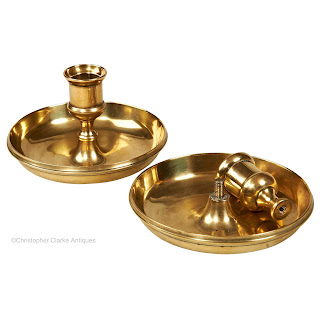
From approximately 1735 through 1925, explorers, travellers, military officers, and European Royalty all employed a distinctive type of folding candlestick on their journeys. Perhaps because of their resemblance when packed for travel to a now-forgotten English pastry, these candlesticks are colloquially and affectionately referred to today as 'Brighton Buns.'
A Brighton Bun consists of two drip-pan bases that screw together in such a way that they form a circular bun. When unscrewed, the bases divide into two equal halves, revealing two loose candle cups. When upturned, the drip pans form the bases for two chamber candlesticks into which the candle cups are screwed. The candle cups are sometimes embellished with ring turnings, flared lips, or ejector slits through which the candle stubs may be removed. The more elaborate Brighton buns contain conical snuffers.
The bases of these elegant and useful travelling chamber candlesticks range in size from approximately 3 ¼ inches to 6 inches in diameter: Brighton Buns were made by casting, spinning, or pressing brass, bronze, and copper; rolling and spinning Britannia metal; hammering or pressing silver; or turning wood on a lathe. Examples have been recorded in a variety of woods, ranging from olivewood, yew, and elm to ebony and Karelian birch. By the early twentieth century, the traveller could order Brighton buns plated in silver, covered with 'Russia leather', 'American cloth,' or, for the more affluent, 'Crocodile leather.'
![]() |
| Karelian Birch Candlesticks |
John Caspall has observed that 'Soon after their introduction, and in their early years, Brighton buns were invariably cast from brass or bronze, were always quite heavy, and carefully lathe-finished... Much lighter 'basin-halves' were formed by pressing from sheet material, and the rims were sufficiently thickened by rolling to permit a fine circumferential thread to be cut.'
Although the majority of Brighton buns currently on the market are of English manufacture, and more often than not made from pressed or cast brass, they were in fact made in a variety of countries, including Germany, Austria, and the United States.
![]() |
| Britannia Metal Mikitary Candlesticks by James Dixon & Sons |
During the height of British imperialism, travelling brass candlesticks found their way to some of the farthest corners of the Empire. They were considered essential travelling kit by such early explorers of the Canadian frontier as David Thompson (1770-1857), a geographer who was based in Rocky Mountain House, a fur-trading post on the North Saskatchewan River in Alberta, British Columbia, at the turn of the nineteenth century. In A History of Rocky Mountain House, Hugh Aylmer Dempsey published lists from early nineteenth century invoices and inventories that show the kinds of goods shipped by the North West Company's Columbia Department for the Indian trade in Montreal. In addition to axes, blankets, belts, garden seeds, ivory combs, playing cards, chocolate, coffee, cinnamon, cloves and camphor requested for the years 1807-1808 there is an entry for 'candlesticks, brass camp.'
Not only were Brighton Buns used by senior officers in the British army and intrepid explorers of the Canadian frontier, but also by European royalty. An exceptional pair of sterling silver Brighton buns engraved with the monogram of Queen Charlotte Sophia, the consort of King George III (r: 1760-1820), and bearing hallmarks for 1808, appeared on the market in 2000. Franz Joseph I, emperor of Austria (r: 1848-1916) was an avid collector of lighting devices that were popular in Austria and the Alpine countries from the fifteenth to the eighteenth centuries. Among the devices in his collection was a pair of Brighton buns that Franz Joseph's cataloguer called a 'traveller's candleholder, which when opened and put together, provides two candle sockets and two bases.'
Brighton Buns were also popular in America during the Civil War and well into the late 19th century. Illustrations of 'Camp Candlesticks' appear in the Catalogue of Arms and Military Goods published by the New York military furnishers Schuyler, Hartley & Graham, in 1864. Similarly, in 1896, the Gorham Manufacturing Company of Providence, Rhode Island, illustrated a 'Travelling Candlestick' in their Catalogue of Sterling Silverware.
Though the Army & Navy Co-operative Society, arguably the most popular military and colonial outfitter of the Victorian and Edwardian periods, did not include Brighton Buns in their Price List of 1881, by 1907 they were offering Brighton Buns for sale under the catalogue headings 'Barrack Furniture and Camp Equipment,' where they are referred to as 'Brass Folding Candlesticks.' They were also offered for sale through the Ironmongery Department, where they are described as 'Military, brass.' At the same time, under the heading 'Stationery Fancy Goods,' they offered 'Travelling Candlesticks' covered in 'Russia leather,' 'Crocodile Leather,' 'Brass, 3 3/8 in. diameter,' 'Brass 3 7/8 in. diameter,' and 'Silver, 3 5/8 in. diameter.' Similarly, around 1910, Harrod's Supplementary Export Price List offered 'Brass Candlesticks,' both 'large' and 'small' under the catalogue heading 'Barrack Furniture and Camp Equipment Department.' Brighton Buns were still being advertised for military use by the Army & Navy Stores as late as 1925, when a pair of 'Brass Folding Candlesticks' is illustrated in the catalogue in the 'Barrack Furniture and Camp Equipment Department.'

In 1787, A. Hepplewhite and Company published its belief that 'to unite elegance and utility and blend the useful with the agreeable has ever been considered a difficult, but an honourable task.' Brighton buns realize this maxim to the letter.
Nicholas Brawer is the author of British Campaign Furniture: Elegance Under Canvas, 1740-1914, published in 2001 by Harry N. Abrams, and was the curator of Britain's Portable Empire: Campaign Furniture of the Georgian, Victorian and Edwardian Periods, an exhibition held in 2001 at the Katonah Museum of Art in Katonah, New York. Nick has a shop in New York at 28 East 72nd Street at Madison Avenue.
![]() |
| Silver Brighton Bun Candlesticks dated 1839. |
The examples of Brighton Buns illustrated here are ones that we have sold. Further examples of travelling candlesticks can be seen on our website by searching 'Brighton Bun' or clicking on this link.
Williams Tonks & Sons connection to Campaign Furniture.
Our father Christopher Clarke was born in Birmingham to a long line of medical for-bearers however, part of the family tree relates to Henry Tonks. You can follow the link for more in depth information but he was a surgeon whose family owned a brass foundry in the city and was also famous for teaching art at Slade School of Fine Art with Rex Whistler being one of many of his notable pupils.
The foundry Henry Tonks' family owned were called William Tonks & Sons and though maybe not as well known as Coalbrookedale and Archibald Kenrick were one of the largest and most prolific metalware making companies in Great Britain during the 19th century. If you are interested in marked metalware do look at Vin Calcutts excellent The Old Copper Website and you can read up more on the Tonks Foundry. there as well as identifying other marked metalware.
As you will know, if you are familiar with our website, with Birmingham being the workshop of the world in the 18th and 19th century here and across the country there were a vast amount of metalware manufacturers producing a vast array of goods that could be used for travelling or by makers of campaign furniture.
Firstly, items in brass and iron such as beds and chairs such as the wonderful folding iron bed and the iron duoro chair in our last catalogue. As well, as this we have had showers and items such as washstands and shelves which brass components.
Secondly, there will be the component parts of chests, tables, bookcases etc that have iron or brass fittings. Flush handles, brass strapwork, escutcheons, brass ferules, thumb bolts and threaded fittings to brass hooks and hinges etc.
So how do William Tonks & Sons fit into picture of what was being produced that could be useful to the campaign furniture cabinet maker or traveller? Unlike specialist makers such as Winfield or Hoskings who made specific finished items ready to be retailed Tonks made a huge amount of different items that other manufacturers could use in their designs as well as items for use in a more architectural context such as door knockers, window latches and door plates.
We have seen W T & S items such as table clips, handles and hinges so it would be reasonable to assume that they also made campaign handles and brass strapwork for campaign chests. Strapwork would not be marked and most campaign or military handles (if they are marked) are marked on the back so you would not know unless you removed them. Interestingly, our father on a visit to the USA over 40 years ago spotted Tonks hinges on an American late 18th bureau bookcase. Tonks exported world wide so pieces of their metalwork will appear on colonial furniture possibly misleading the uninitiated into thinking the piece is English.
The box below was certainly English and had hinges by William Tonks.
We have handled a few other pieces which could be classified as campaign or travel. One of the most iconic pieces of campaign equipage would be the Brighton Bun. Tonks made a nice example of these which we know because they marked the outside of the dishes. Generally, when we see them of this size they tend to have pressed dishes and light weight sconces. The Tonks examples which would predate these have case dishes and sconces and though small feel more substantial.
Another piece of brass ware we usually have in stock would be the Walkers Patent hooks. First patented in 1864 they continued to be made into the 20th century and can still be found in William Tonks catalogues of this date. On the earlier examples which come in several sizes they will be stamped Walkers patent 1864 to the front and those made by Tonks will have the WT & S mark to the back alongside the sun motif they used during the period.
At present we have a stylish pair of candelabra marked WT & S which are designed to be screwed on to a wooden base. It is possible that they could have been for use on board ship where falling candlesticks could be particularly dangerous.
As more items come to light this page will be updated with further information.
Simon Clarke
Tuesday, 5 February 2019
Thomas Butler - The Grandfather of Campaign Furniture Makers?
![]() |
| Chair Bed by Thomas Butler |
![]() |
| Extended as a bed |
![]() |
| A small Imperial Table. |
Although Johnson and Waldron were fore runners to Butler in Catherine Street and Morgan & Sanders are perhaps the most recognised name of the two today, Butler’s influence on campaign furniture should not be under estimated. He capitalised on the interest in metamorphic furniture and the demand for campaign furniture. In doing so, he also paved the way for the other businesses to profit from the same markets. We group Butler, Morgan & Sanders, Oxenham, Argles, Steains, Pryor & Mackenzie and John Durham as the Catherine Street makers not just because of their location. They all produced very similar pieces, working to a number of the same designs which were first popularised by Butler. So much so that it can be difficult to determine which of them made one of the recognised designs without a maker’s label.
Saturday, 7 April 2018
A Rare & Unusual Georgian Campaign Table.
![]() |
| A Rare & Unusual Georgian Campaign Table. |
Once seeing this you next thought might be " The top is from a card table. That can't be right." You decide to have a closer look and see what its all about.
So what do we notice from this photo:
1. The top is hinged but not folding upwards like a card or table but downwards. Most odd.
2. The timber to the top and side rails is a dense Cuban mahogany.
3. Unusually, the legs with their boxwood stringing are made of a lighter possibly Honduras mahogany. Can this table be right ?
Lets have a look underneath and see whats going on.
So, what can we deduce from this?
From the style of the square tapered legs with the boxwood stringing this table would date to around 1790. We know that at this period in the second half of 18th century cabinet makers were experimenting with different designs to make furniture that could be dis-mantled to make it portable.
At this period the campaign furniture would look like its domestic equivalent and would usually be made by cabinet makers rather than makers who specialised in travel furniture. Some of the known furniture designers of the time included some portable furniture in their design books but there were not, that we have discovered, that many designs available for their subscribers.
For this reason we occasionally come across furniture which we believe were bespoke made for a client and possibly one off pieces. I believe that to be the case with this table.
Two last details that should be mentioned are that all the fitting are iron as opposed to brass which is unusual. Possibly, even blacksmith made that leads me to believe that the table is more likely than not made by a provincial cabinet maker. Secondly, why did the maker not put hinges to the top section the other way around to allow the top to close and protect the polished surface as opposed to this way that means it will not close flat as the iron hinges are in the way?
By Simon Clarke.
Saturday, 2 September 2017
John Folgham, case and knife case maker.
Whilst, visiting the wonderful National Trust Property Chastleton House ,which is just down the road from the shop, I noticed this fine Georgian Knife box which I hadn't recalled seeing before.
This box with its serpentine front is much like like many that you will see in many country houses.So what made this box stand out you might ask ?
On the wall behind the box is the framed original invoice supplied by the maker John Folgham in 1787.
Any ideas ?
Referring to The Dictionary of English Furniture makers,1660-1840 we see this on the maker:
Saturday, 1 April 2017
Campaign or Military Chests - Beginners Guide Part 2.
Where was it made ?
This can sometimes be a little tricky to the un-trained eye as a lot of campaign chests can at first glance all look the same. On closer inspection, following a few guidelines you should be able get a reasonable idea where a campaign chest was made.
We have had military chests made in England, Ireland, Scotland, Malta, Australia, China, India and some from places in the East and the colonies that we have not as yet been able to pinpoint.
|
|
When evaluating a campaign chest consider the following and it should be possible to work out where a campaign chest was made. Maker's name, timber, construction techniques, and hardware.
If on inspecting your campaign chest you see a maker's name there will be a good chance you will be able to find out where they were based. If their details are on a label or stencil there is also likey to be their address. So look out for paper labels, ivory, ivorine or brass plaques, stencils or stamps. If only a name, a little research should provide more information on where a company were based. You will still need to follow the other indicators as its is possible a maker may have made chests at home and abroad. Be also aware that sometimes maker's marks can be fraudulent and not original to the piece.
|
|
Occasionally, you may come across a British made chest that doesn't have a maker's name but on closer examination you may see pencil inscriptions. These are likely to be on the secondary timbers on the carcase or drawer bases or backs and can include cabinet maker's name, date, or merely a number given to a drawer or if it is for the top right or left side.
![]() |
| Pencil inscription on A&N CSL teak chest shown below. |
|
|
In the knowledge of the different construction techniques used in British cabinet work and those used abroad we find some strong indicators as to where a chest was made. This, like the knowledge of timbers, can take a while to fully understand. 18th and 19th century British cabinet work is second to none in quality so generally easily recognisable. For the novice a good starting point will be to inspect the dovetail joints on the drawer construction. A finely cut dovetail joint is easily distinguishable from a larger and sometimes far cruder colonial equivalent. Be aware though that by the end of the 19th century some British cabinet makers had embraced modern technology and had started to use machine cut dovetail joints that like the colonial equivalent will be larger and cruder. For the more experienced collector closer inspection of campaign chests construction will show a marked difference in those made in Britain and the colonies.
|
|
A final great indicator to the whereabouts of where a chest may have been made is the metal hardware used by the maker on their chests. Though there are differences, both in style and manufacture in British made handles, corner pieces and brass strap-work and those made in the colonies this can be a difficult one to use as an indicator of construction origin. Apart from the lower quality sheet brass strap-work and lower grade skeletal handles found on some Anglo-Indian chests, differentiating between the British made and higher quality colonial brass work can be quite tricky. However locks can sometimes be an easier one to examine. A lot of British locks will provide a few clues that show they are British. There may be the maker's name which research can provide a whole host of information. They may have evidence of the reigning monarch with either a GR or VR indicating Georgian or Victorian period. You may also see "patent" or "4 lever" which are good signs they are British. A note of caution though: it was quite common for British hardware to be exported to the colonies to be used in furniture made in that country. Also, it is not unusual for locks to get replaced on chests. For this reason using just one of the above indicators should not be relied on to show where a campaign chest was made. However, using a combination of all of the above may help even the novice to get some idea of country of origin.
|
|
The study of origin of colonial chests is an area that still requires much research. Chinese Export chests may be easily distinguishable but it should be remembered that Chinese cabinet makers were working not only in China but right the way across to the west of Canton and into India. It can be possible to differentiate chests made by Chinese cabinet makers working in India through their quality, and the construction techniques used but the waters can get somewhat muddied. It is hoped in the future with more information coming to light that this should become easier and we will know which chests made in India were by local cabinet makers, Chinese cabinet makers or those made by English cabinet makers who had set up workshops in the country.
Hopefully this will give you some help in tackling this somewhat complex issue and should enable you to at least determine if a chest is British made. As mentioned, moving on to the colonies may take a little more time and experience. You may also be able to use the above in considering other types of campaign furniture as most will be equally relevant to chairs, tables etc.
By Simon Clarke.